How we ended up here
I had a conference in Phoenix. That is the whole origin story.
We looked at the calendar, saw we could fly out a couple of days early, and did what we always do: pulled up a map and looked for something within driving distance we had not seen yet.
Saguaro National Park sat about two hours south, just outside Tucson, straight shot down I-10. No drama, no elevation, no weather to worry about in April. The kind of drive where you leave with coffee and arrive before you have finished the podcast.
We gave it one day. That turned out to be exactly right.
The drive down
Leaving Phoenix early is the move. April is genuinely pleasant in the morning and genuinely warm by mid-afternoon, so the earlier you are on the trail, the better the day goes.
The stretch of I-10 between Phoenix and Tucson is not scenic in any dramatic way. Flat, open, brown. That makes the arrival better: you go from generic interstate desert to saguaro forest fairly abruptly, and once the cactus start showing up, they do not stop.
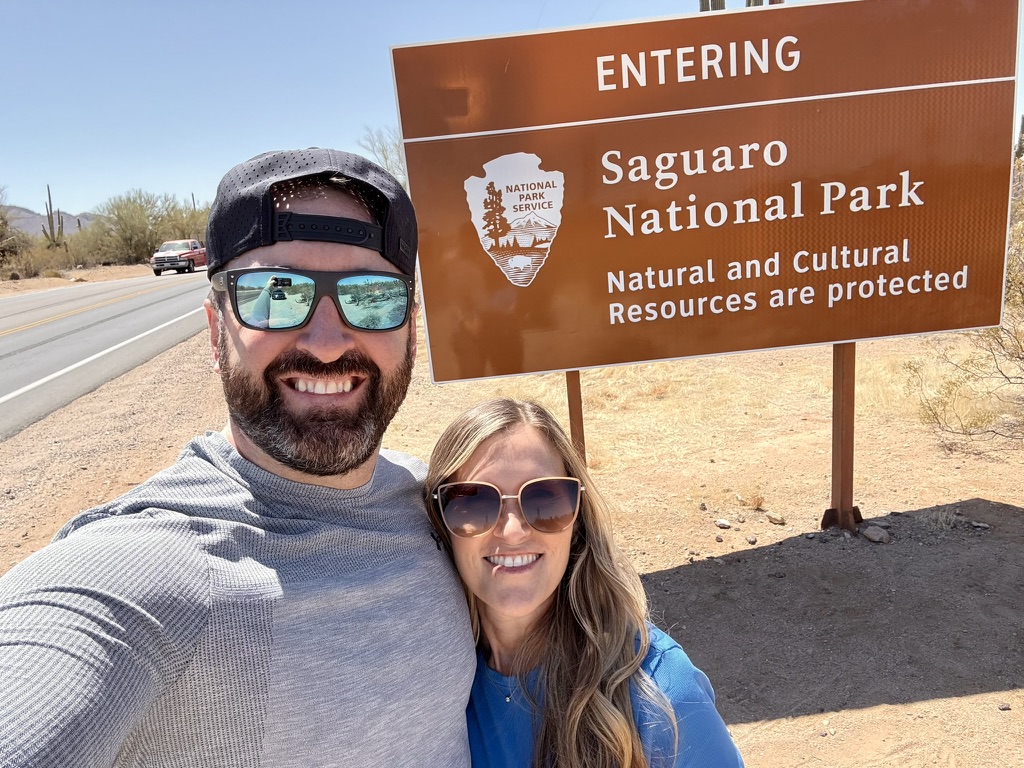
We stopped for the obligatory brown-sign selfie at the park entrance. Non-negotiable.
 Photoassets/saguaro-sign.jpeg
Walking among giants
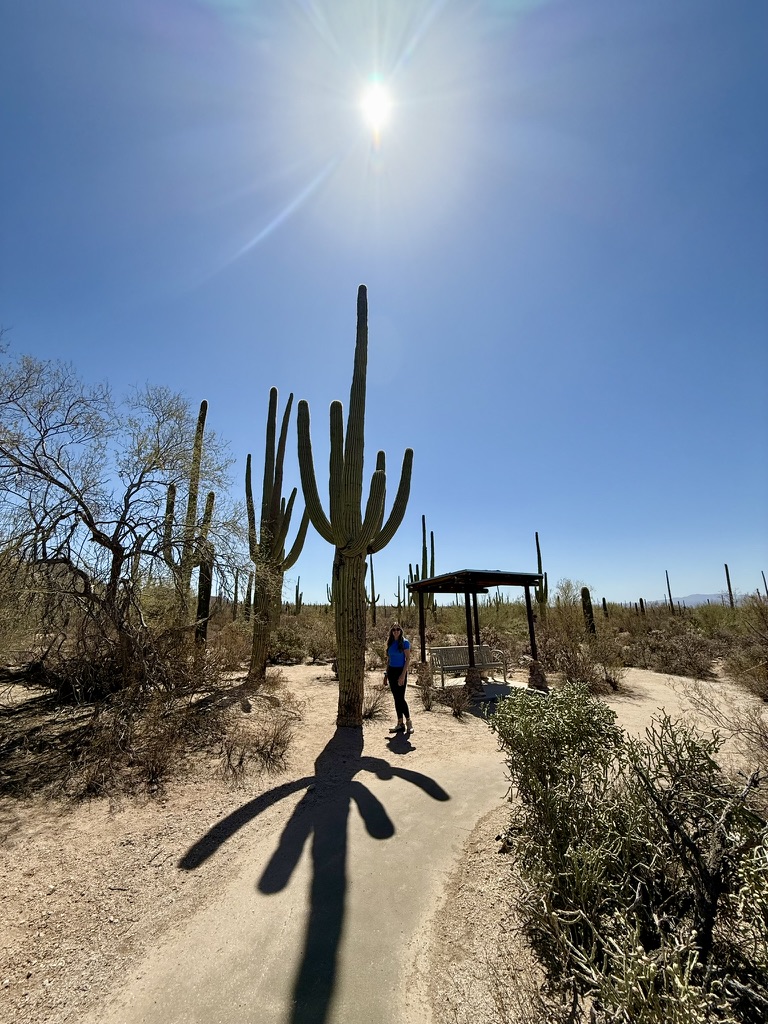
The thing photos do not prepare you for is scale. You have seen a saguaro on a postcard, a license plate, a Looney Tunes background. You have not stood next to one.
Trisha posed next to one that made her look like a garden gnome. That is not an exaggeration of perspective. These things are genuinely enormous.
 Photoassets/saguaro-giant.jpeg
The fact that changed how we looked at the whole park
According to the National Park Service, a saguaro is composed mostly of water, 75 to 90 percent of the plant's mass, and its branches normally begin to appear at 50 to 70 years of age. Both figures are from Saguaro Cactus: Sentinel of the Southwest.
Being mostly water is why a big one can weigh several tons after a good monsoon. The pleats running up the trunk let it expand and contract like an accordion as it takes the rain on and gives it back.
National Park Service. (2016). Saguaro cactus: Sentinel of the Southwest. U.S. Department of the Interior.
National Park Service. Saguaro. Tonto National Monument. On the pleats.
The rest of the timeline is just as slow. They grow an inch or so in their first several years, they do not flower until their thirties, and they are not fully grown until well past a century. Most live between 150 and 175 years. Some push past 200.
So when you are standing in front of a multi-armed giant, you are looking at something that was already alive during the Civil War. That saguaro was a tiny green nub under a palo verde tree while the country was still working out what it was, and every arm is another half-century of standing there quietly through 110-degree summers.
They also grow only in the Sonoran Desert, nowhere else on earth. You cannot see this anywhere but here.
That reframed the whole walk. It stopped being "look at the cool cactus" and became "look at this 200-year-old organism that is mostly water and has been standing in this exact spot since before Arizona was a state."
The trails
We only walked the loops right around the visitor center, and that was plenty. Short, good views, no death marches. In April that is the correct strategy anyway: the sun is direct, there is essentially no shade, and the desert does not care about your fitness goals.
That is the underrated thing about this park. You do not have to earn the view. The trails leaving the visitor center are flat, well marked, and immediately dense with saguaro. Ten minutes from the parking lot you are surrounded. There are ramadas with benches at intervals, which we appreciated more than we expected to.
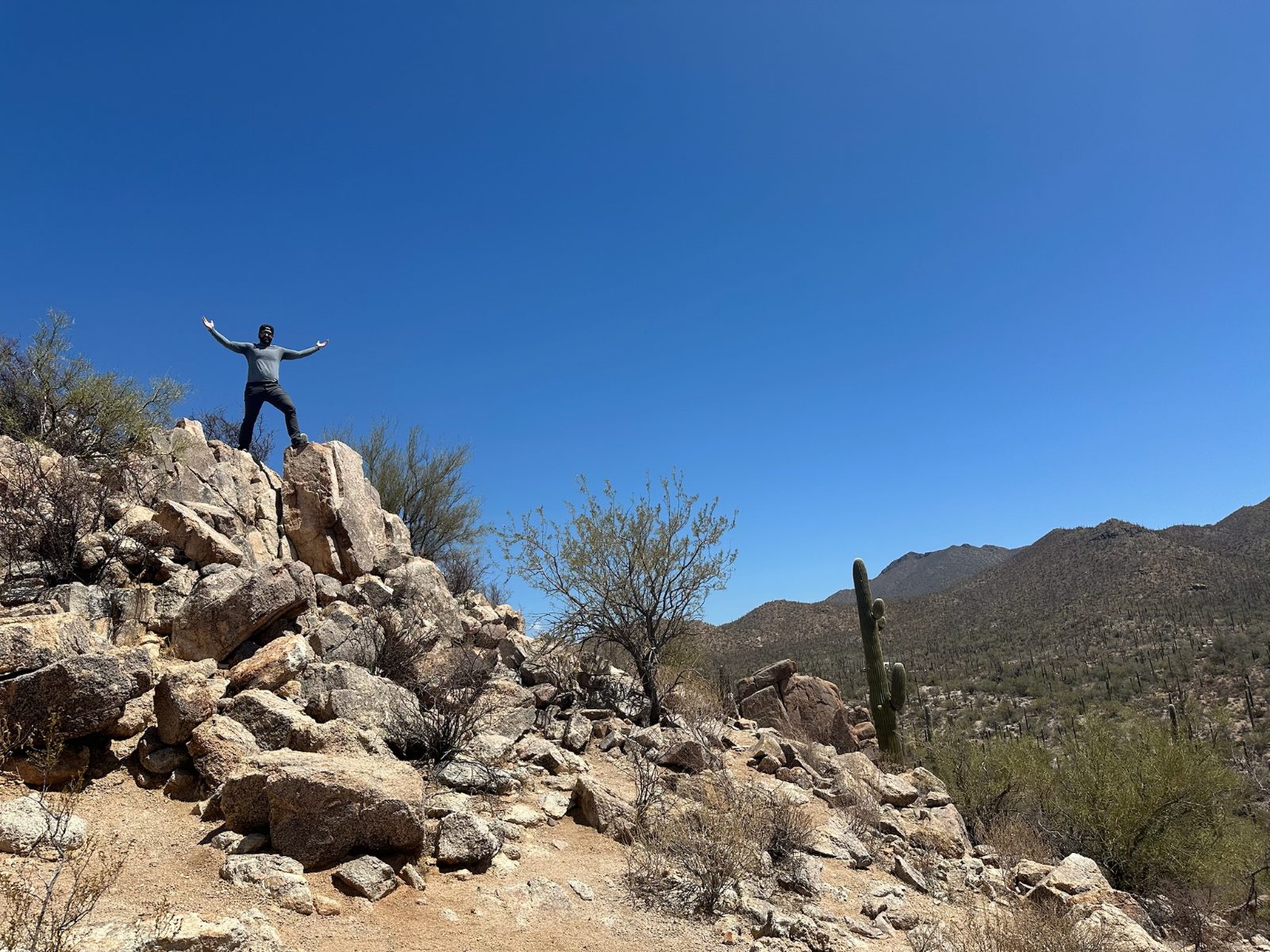
The terrain shifts quickly too. One stretch opens into a pile of pale granite boulders stacked at odd angles, with the cactus forest and the mountains spread out behind. I scrambled up on top of one for a photo, as one does. Trisha shot it from below, which is the only reason it looks impressive.
 Photoassets/saguaro-outcrop.jpeg
The visitor center, and the nightmare box
Go inside. Seriously. It is small but well done, and the ranger staff know their stuff.
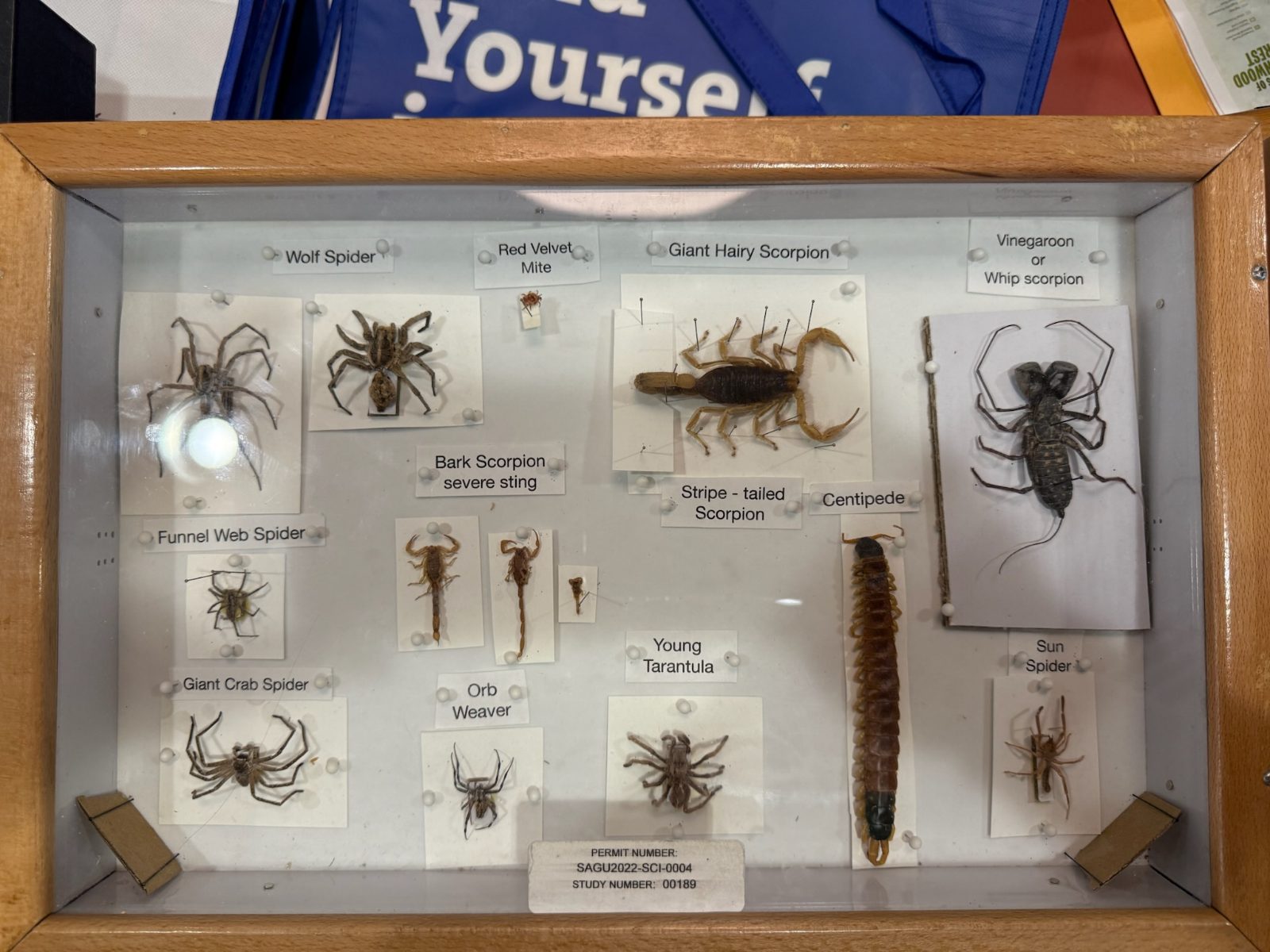
They also have a display case of pinned local arachnids that I could not stop looking at. Wolf spider, giant crab spider, funnel web spider, orb weaver, sun spider, a young tarantula, a red velvet mite, and a centipede roughly the length of my hand. A vinegaroon, which looks like something that lost a bet with evolution. And three scorpions, one of them labelled simply "Bark Scorpion, severe sting."
 Photoassets/saguaro-display-case.jpeg
The scorpion fact
Scorpions glow under ultraviolet light. A substance in the exoskeleton fluoresces bright blue-green under a blacklight, so you can walk into the desert at night with a cheap UV torch and watch them light up like little neon signs from several feet away.
Nobody is entirely sure why. One theory is that the fluorescence works as a whole-body light sensor, helping them read moonlight and decide whether it is dark enough to hunt. Newly moulted scorpions do not glow at first. They have to age into it.
The other thing worth knowing: the Arizona bark scorpion is the most venomous scorpion in North America, and in that case it is also one of the smallest. The giant hairy scorpion pinned right above it is several times the size and far less dangerous. Size tells you nothing.
Stings are common in Arizona and genuinely painful, but modern antivenom means serious outcomes are rare. Still, check your shoes.
We are now both people who own a blacklight.
The stop that stole the day
Here is our actual recommendation, and it might be the best thing we did all day.
On the way out of Tucson we stopped at Tohono Chul, a botanical garden and nature preserve on the northwest side of the city, and had brunch at the Garden Bistro.
It is set in a hacienda-style house with shaded patios opening onto desert gardens. Hummingbirds, fountains, actual shade, which after a morning in the park felt like a luxury good.
 Photoassets/saguaro-brunch.jpeg
Trisha got a quesadilla with charro beans and salsa. I got eggs with avocado, smashed potatoes and toast. The menu leans on local Sonoran ingredients, some of it grown on the grounds, and they do a prickly pear margarita that is apparently a local institution.
Five out of five, no notes. It was the right amount of cold drink, real food, and sitting down at exactly the right point in the day. If you do this trip, do not skip this stop. Reservations are recommended for larger groups, and it gets busy even on weekdays.
The verdict
One-Time Visit
And we mean that as a compliment.
Some parks are destinations. You plan a week around Zion or Yellowstone and still leave with a list of things you did not do. Saguaro is not that. It is a day. The whole point of the place is a single overwhelming species, and once you have stood next to a 200-year-old saguaro, walked a couple of trails and looked at the scorpion box, you have received the message. Clearly, and in full.
That is not a knock. It is a genuinely beautiful, unusual, well-run park, and it is the only place on the planet where you can see this particular landscape. The fact that it fits neatly into one day is a feature, not a flaw. It made a work trip into a real trip.
If you find yourself in Phoenix with a free day, go. Leave early, walk the easy trails, drink more water than you planned to, and get brunch at Tohono Chul on the way back.
Then check the box and go find the next one.